Can the business stay open during drying?
Often part of it can. Containment and equipment placement are planned so open areas stay usable and safe.
A flooded storefront loses money every hour it stays closed. The restoration team extracts, dries and documents around business hours where possible, so the shop, restaurant or office can open again.
(888) 527-9860Business flooded? Call the restoration team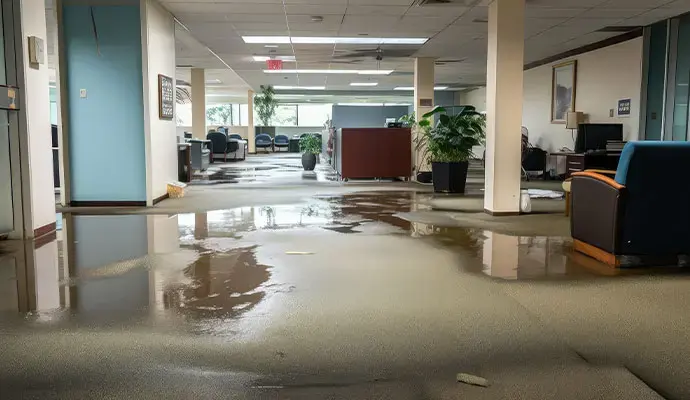
Close the water valve and shut off power to wet areas at a dry panel.
Lift inventory, menus, paper records and electronics off the floor.
Notify the landlord, the units above and any tenants sharing the space.
Photos of stock, equipment and the waterline for the business policy.
In Woodside, NY, commercial water damage restoration typically runs $3,000 to $10,000 for a single storefront or office, and $10,000 to $40,000 or more for restaurants, basements under stores or multi-tenant buildings. Square footage, the water category and after-hours scheduling set the number.
For a planning number on your own loss, try the water damage cost calculator. The final figure comes from the on-site walkthrough and the moisture map.
The tech who does the walkthrough maps the loss and plans the work around opening hours and tenants.
Truck-mounted extraction and pumps clear large floors, kitchens and basements under storefronts.
Large-loss dehumidifiers and air movers run, with containment to keep dust and air away from open areas.
Daily readings, photos and a line-item scope support the property and business claims.
Roosevelt Avenue under the elevated 7 and the blocks around the 61st Street station are lined with restaurants, groceries, salons and small offices, usually with apartments upstairs and a cellar below. A water loss there affects the business, the building and the tenants all at once.
Storm-driven backups under stores follow the same Category 3 rules described on the sewage backup page.
The mitigation team plans the work with the owner: which areas can stay open, where containment goes, and when the loud equipment runs. Food-service areas get cleaned and treated before drying, and anything porous touched by contaminated water is removed. Daily readings show when each area is ready to reopen.
A commercial claim usually covers the building, the contents and sometimes lost income, and each needs its own proof. The restoration file carries the moisture map, daily psychrometric logs, timestamped photos before demolition and a line-item scope in the format adjusters expect. Coverage depends on your policy, so it is worth checking with your own insurer and broker.
Worker safety during flood cleanup is covered by OSHA, and the city's Department of Environmental Protection handles sewer and water service issues in the street.
The Woodside restoration crew works every section of 11377, from Winfield to Boulevard Gardens, plus Sunnyside, Jackson Heights, Elmhurst, Maspeth, Astoria, East Elmhurst.
See every Woodside section coveredOften part of it can. Containment and equipment placement are planned so open areas stay usable and safe.
Yes. Extraction and equipment setup are often scheduled around opening hours when the loss allows.
Items touched by clean water may be saved; anything porous touched by Category 3 water is discarded and documented for the claim.
Every affected unit gets its own moisture map and drying setup, and its own documentation.
A contained loss often dries in three to five days; basements, kitchens and large areas take longer.
Some business policies include business interruption coverage. Coverage depends on your policy, so it is worth checking with your own insurer.
Commercial losses mix inventory, equipment and tenants above. A clear plan and daily logs keep the downtime short.