What is IICRC S500?
It is the industry standard for professional water damage restoration. It covers inspection, categories and classes of water, drying equipment and verification.
Surface dry is not dry. The drying team dries the plaster, framing, subfloor and masonry to readings within 2 to 4 points of a dry reference, and the equipment leaves on readings, not on a schedule.
(888) 527-9860Walls still wet after a leak? Call now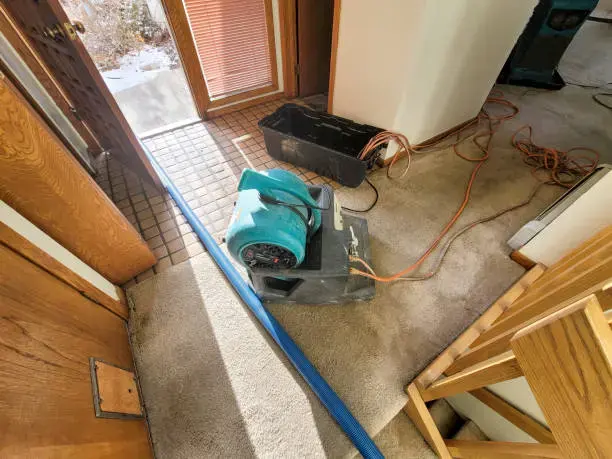
A comfortable room temperature helps drying; do not crank the heat or leave windows open in humid weather.
Air movers and dehumidifiers work around the clock. Unplugging them resets the progress.
The drying team closes or opens rooms on purpose to control the air.
Tell the crew at the next reading so the moisture map can be updated.
In Woodside, NY, structural drying typically runs $900 to $3,500 for one or two rooms and $3,500 to $10,000 for a floor, a cellar or dense materials like plaster and hardwood. Class of loss, square footage and how many days the equipment runs set the number.
For a planning number on your own loss, try the water damage cost calculator. The final figure comes from the on-site walkthrough and the moisture map.
Pinless and pin meters plus thermal imaging record every wet area before equipment goes down.
Air movers are set to the evaporation load of each room and LGR dehumidifiers to the water in the air; desiccants go in for Class 4.
Psychrometric readings (temperature, humidity, grains) and material readings are logged every day.
Equipment comes out when wet materials read within 2 to 4 points of a dry reference in the same building.
Structural drying is what separates a finished dry-out from a cosmetic one. Woodside buildings are full of materials that hide water: plaster on lath, hardwood over plank subfloor, brick party walls and concrete cellar slabs. They can feel dry on the surface while the inside is still wet.
IICRC S500 is the industry drying standard. It starts with moisture mapping before any equipment goes down, so the drying plan matches what is actually wet. It classifies the loss: Class 1 through 4 sets how much equipment a room needs, from a small area of low-porosity material up to dense materials like brick, plaster and hardwood that need desiccants and more time.
Air movers create airflow across wet surfaces so water evaporates. LGR (low grain refrigerant) dehumidifiers pull that water back out of the air; desiccant units take over when the air is cool or the materials are dense. The drying team records temperature, humidity and grains per pound daily, along with material readings at the same marked points, and adjusts the setup as the numbers move.
EPA indoor air quality material explains why controlling indoor moisture matters for the people living there.
The drying goal is within 2 to 4 points of a dry reference material in an unaffected part of the same building. When the wet materials hit that mark, the equipment comes out and the drying log closes. That log, with the moisture map and photos, is what an adjuster looks for. Rebuilding, meaning new drywall, floors or paint, is a separate phase that starts after the structure is dry.
A contained Class 1 loss usually dries in three to five days; hardwood and plaster take longer. See water extraction for the step that comes before drying.
For what to do before and after water gets into a building, see NYC Emergency Management flood information.
The Woodside restoration crew works every section of 11377, from Winfield to Boulevard Gardens, plus Sunnyside, Jackson Heights, Elmhurst, Maspeth, Astoria, East Elmhurst.
See every Woodside section coveredIt is the industry standard for professional water damage restoration. It covers inspection, categories and classes of water, drying equipment and verification.
The surface dries first. Plaster, framing and subfloor hold water inside, and readings show when they are actually dry.
A reading from the same material in an unaffected area of the building. The goal is to bring wet materials within 2 to 4 points of it.
Air movers and dehumidifiers are noticeable but safe to live around. The drying team places them to limit disruption where possible.
Often, when the water was clean and drying started quickly. Readings and the condition of the plaster decide.
Three to five days is typical for a contained Class 1 or 2 loss. Class 3 and 4 losses with masonry, plaster or hardwood take longer.
Moisture left inside framing and plaster causes the damage that shows up weeks later. Drying to readings stops it.